Talent is the Technology!

Updated: Aug 12
Richard Wright | Wright Thinking
There is a question I used to ask whenever someone came to me asking about our agency. It didn't matter whether they were a prospective client, a journalist, or a competitor trying to work us out. The question was always the same: what do you think makes a studio great?
The answers were almost always variations on the same theme. The render pipeline. The software licences. The hardware. The real-time capability. The AI tooling. The tech stack, in other words. And I understand why — the technology is visible. You can point at it, benchmark it, put it on a capabilities deck. It feels concrete.
But it's wrong. Or rather, it's incomplete in a way that matters enormously.
The best studios I have seen — and over twenty-five years I've seen a lot of them — are not defined by their technology. They are defined by the people who use it. Technology is a multiplier. Talent is the base number. And you cannot multiply zero.
The Three Promises
When I was COO and then MD at Burrows, I made a point of sitting down personally with every new starter. Not a formal induction, not a HR briefing — just a conversation. I wanted them to understand, from the beginning, what kind of place they had joined and what I was going to ask of them and, crucially, what I was going to give them in return.
I made three promises to every one of them.
You will have fun. You will work hard. And you will grow — as a person and as a creative or a scientist.
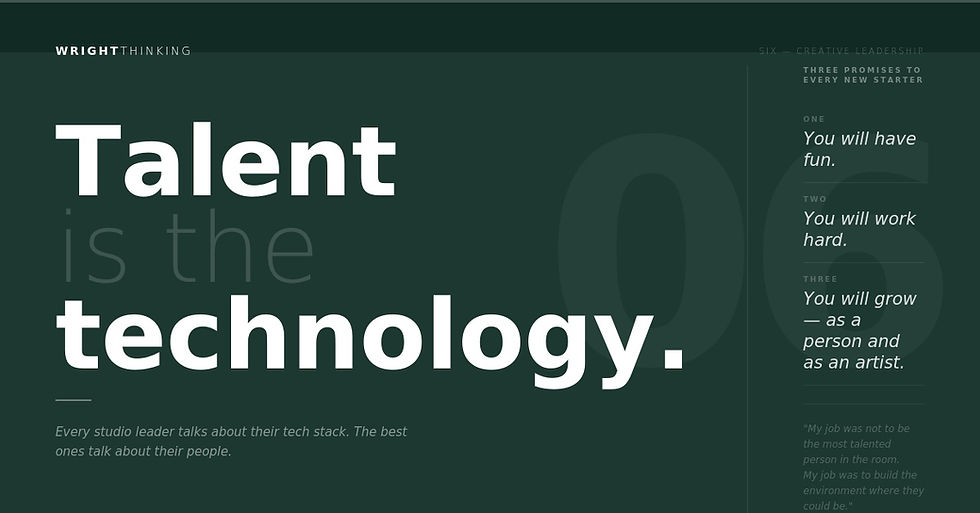
And then I said something that I meant completely and that I think surprised a few of them. I told them that I did not have their skills. I could not do what they did. I was not the most talented person in the room, and I was not pretending otherwise. My job was not to be. My job was to build the environment in which they could be — an environment where they could flourish, develop, and reach their full potential.
My role was to get out of their way, and then quietly make sure the conditions were right for them to do extraordinary things.
That philosophy shaped everything. Hiring, development, culture, retention. All of it flowed from those three promises and that one honest admission.
Hiring: Attitude First, Skill Second
Here is something I learned early that took a while to articulate properly. You can teach someone a software package. You can teach someone a pipeline, a workflow, a rendering technique.
What you cannot teach — or at least cannot teach reliably — is curiosity.
You cannot install a hunger to get things right. You cannot patch in the resilience to take difficult feedback and come back better.

When I was hiring, I was looking for those things first. I wanted to understand how someone thought about problems. Whether they lit up when they talked about their work. Whether they were honest about what they didn't know yet.
Whether they were going to bring something to the culture as well as to the render queue.
The highly skilled candidate who was not curious, not collaborative, not prepared to grow — that candidate was a risk. Because a studio is not a collection of individuals working in parallel. It is a system. It breathes together.
A single person who stops growing can do more damage than you might expect, because creative environments are contagious in both directions.
Skill matters, clearly. But attitude is the foundation everything else is built on.
Development: The Technical Environment is Not an Excuse
Developing talent in a studio is genuinely hard. It is a highly technical environment, the tools change constantly, and there is always pressure to bill hours rather than build people. I have seen studios where development amounts to: watch what the senior artist does, and eventually you will figure it out. That is not development.
That is hope dressed up as a strategy.

What I tried to do — and what I think the best leaders in this industry do — is treat the technical complexity not as a barrier to development but as the medium through which it happens. The craft of CGI is learned by doing, yes. But it is shaped by conversation. By critique that is honest and generous at the same time. By giving people work that is slightly beyond their current comfort level and then being present enough to catch them when they need it.
The team we built at Burrows and, later, working with the team at Hogarth, covered an extraordinary range: automotive, aerospace, consumer electronics, property, jewellery, food and beverage. That breadth was itself a development engine. Artists who had spent two years doing automotive cutaways would suddenly be working on beauty pack shots, and everything they knew about light and material was still completely relevant — just applied differently. Cross-sector experience makes better artists. It also makes them more resilient, more adaptable, and harder to replace.
Retention: This Is a Leadership Issue
Let me be direct about something that I think the industry gets wrong. When a studio loses a genuinely talented person, it is almost never really about the money. Money is usually the reason people give, because it is the easiest to say and the hardest to argue with. But underneath the money conversation is almost always something else: they did not feel seen, they did not feel they were growing, they did not feel the environment was worthy of their best work.

That is a leadership failure. Not an HR failure, not a compensation failure — a leadership failure.
The cost of losing your best people is significant and largely invisible. There is the obvious disruption to projects and client relationships.
There is the recruitment cost and the ramp-up time for someone new. But the deeper cost is the loss of institutional knowledge, of relationships, of the particular combinations of skill and personality that make a team work. Great teams are not assembled — they are grown. And when you lose someone central to that growth, you lose more than their output. The answer is not to pay people more, though you should pay them fairly.
The answer is to build an environment that talented people do not want to leave.
That means genuine investment in their development. It means honest, generous leadership. It means treating them as the assets they actually are rather than as resources to be managed. And it means senior leadership being present and visible — not managing at a distance and expecting culture to sustain itself.
Technology as Superpower
I want to be absolutely clear about where technology fits into all of this. I am not a technophobe. I have led real-time and Unreal Engine adoption at studio level before it was mainstream. I brokered one of the first Epic Games collaborations with a CGI studio outside the games industry. I have spent the last year building digital twin workflows for the construction sector. I believe in tools. I believe in staying ahead of them.

But I have always believed that technology gives talented people superpowers — it does not replace them.
When real-time rendering arrived properly in our world, some people were terrified it would make artists redundant.
What actually happened is that artists who embraced it could do things that would have taken weeks in a fraction of the time, and the creative possibilities expanded dramatically. AI is following the same curve. The artists and leaders who understand what they are trying to say, who have taste and judgement and can hold a quality standard without flinching — they will use these tools to extraordinary effect. The artists who were coasting on technical complexity as a substitute for genuine creative thought will find it harder.
Talent sets the ceiling. Technology raises the floor. You still need the talent.
The Environment Is the Product
Looking back across twenty-five years, the work I am most proud of is not a specific image or a specific client. It is the culture of a studio that consistently produced work at the highest level, that attracted genuinely exceptional people, and that gave those people the space and the support and the challenge they needed to become better.

When I sat down with a new starter and made those three promises — fun, hard work, growth — I was not just setting expectations. I was describing a kind of implicit contract. They were bringing their talent into an environment I was responsible for. My obligation was to make that environment worthy of it.
To create the conditions in which extraordinary things could happen, and then to stay out of the way while they did.
That is what studio leadership actually is. Not the tech stack. Not the client list. Not the awards. The people, and the environment you build for them.
Everything else is just hardware.
By Richard Wright



Comments