Selling the Leap

Richard Wright | Wright Thinking
How to take clients somewhere they've never been.
There's a conversation every agency leader has had, usually in a room with a client's marketing director, that almost nobody writes about honestly. It isn't about the work. It's about money that hasn't been signed off yet, for something the client can't quite picture, that you're asking them to believe in before you've built it. Selling craft is one skill. Selling a leap of faith is another entirely — and after twenty-five years doing both, I've come to think they're the two most different conversations in this industry.

Over the years at Burrows, I learned there are fundamentally two ways this conversation goes, and mixing them up is where studios lose time, credibility, and sometimes the deal itself.
Two types of Innovation Sell
The first is what I think of as a logic sale. The end product stays exactly the same — the client still gets the image, the film, the brochure they were always going to get — but how it's made changes underneath them. Once you can prove the quality holds, this becomes a numbers conversation. Straightforward, in theory.

The second is a vision sale. Here, the end product itself doesn't exist yet, not even in the client's imagination. There's no comparable version to benchmark against, no like-for-like saving to point to. You're not proving something is as good as what came before — you're proving something nobody in the room has experienced yet. Logic alone won't get you there. You have to build enough of the future that the client can feel it before they'll fund it.
Confusing these two is a natural mistake. Walk into a vision sale armed only with numbers, and you'll watch a client's eyes glaze over — they don't yet have the frame of reference to care about your ROI slide. Walk into a logic sale with nothing but a big vision pitch, and a procurement team will quite reasonably ask you to come back with a business case.
The Logic Sale — A Global Client and the Case for CGI at Scale
Burrows had been producing CGI content for a global client across Europe for years by the time this particular conversation happened, and the quality was never really in question — we'd already proven CG imagery could stand in for photography on pre-launch products. What hadn't been proven was whether we could do it at genuine scale, and keep it fresh, while the pressure on the business kept building from three directions at once: earlier content to support pre-sell activity and build order banks ahead of a product launch, a growing need to cut the carbon footprint of physical shoots, and digital channels that were simply hungrier for content than print had ever been.
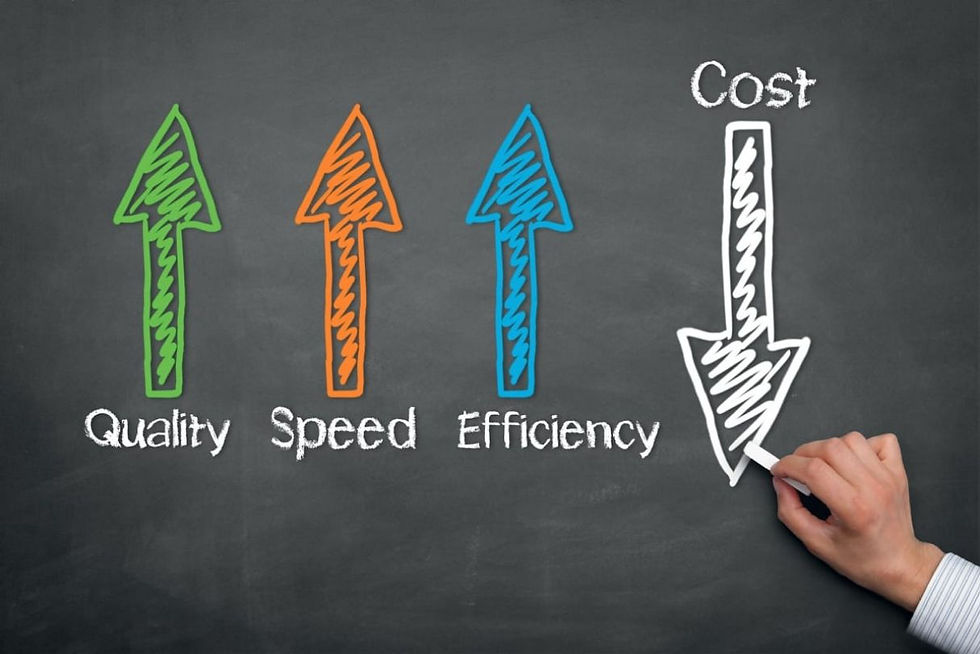
I made the case during an annual scope negotiation, and because the visual quality question was already settled, the conversation moved quickly to where it needed to be — budget and time. I proposed switching a significant share of production to CGI and put a number on it: a 30 per cent cost saving. Not a dramatic, too-good-to-be-true figure that would make anyone suspicious of the quality, but a clean, credible saving that changes how a procurement conversation goes.
The scale, once it was running, was substantial: around 8,000 master images a year, rising to roughly 40,000 once you counted versioning, supporting 30 markets and 20 vehicle lines, twice annually. That's the kind of number that makes an abstract efficiency argument suddenly very concrete.
The resistance, tellingly, didn't come from here you'd expect.
It wasn't the client's marketing team pushing back — it came from some of the partner agencies, and, more uncomfortably, from Burrows' own Art Director, who saw a shift in where creative authority sat. We didn't overcome that by overruling it. We overcame it by making that resistance central to the plan rather than sidelining it — showing the people who felt threatened that they could be the driving force behind the change, not a casualty of it. That's a detail worth sitting with: the hardest resistance to an innovation sell sometimes comes from inside your own building, not the client's.
The Vision Sale — Why Logic Isn't Enough
A logic sale, once quality is proven, more or less sells itself. A vision sale never does. You're asking a client to fund something that doesn't exist against a future they haven't fully pictured, and no spreadsheet does that work for you. What does the work is a proof of concept — built specifically to be just good enough to let the client feel the art of the possible, anchored tightly to a problem they already have or can see coming.
We ran a number of vision sales during my time at Burrows, two inparticular illustrate this precisely, and both are worth telling honestly, near-misses included, because the honest version is far more useful to anyone reading this than a polished success story would be.
The first was a render-on-demand asset generator, built on Unreal Engine, for a global blue-chip client. We could see their challenge clearly: they needed a growing volume of assets to support new product launches, and they had ambitions for a new global website offering content personalised to individual visitors based on their previous configurator behaviour. We built a proof of concept lean enough to prove the tool could work, sold it in to their senior marketing leadership, and the sell-in worked — a team of three to four people spent about six weeks on it, and the client funded the tool being built properly. It proved exactly what we wanted it to prove, about both our capability and Unreal Engine's. What it didn't do was get used to its full potential, because the global website it was built to serve never launched in its planned form. That's not a failure of the sell. It's a reminder that a vision sale can succeed completely and still be undone by something entirely outside your control.

The second was a virtual showhome for a major UK housebuilder. Their existing online configurator which we built, used layered, pre-rendered CGI images, that allowed the potential buyer to configure their Bathroom and kitchen on line once they had bought off plan and placed a desposit. This was an industry first but only helped once someone had bought, how could we help them get orders?

Understandably, house buying is a very phycials thing, you go to view the proprty that you are interested in. You walk around it, image what it would be like living there. Easy for an existing house, but what about a house that is not built yet? Traditionally the first 2 or 3 ploys on a new build site are built as show homes. There purpose it to home the sales team and allow potential buyers to walk around them. The problem is that there are often up to ten different configurations of houses, but only 2 or 3 show homes. We saw an opportunity to solve that with real-time rendering — using the same CAD data and actual house dimensions, we built an immersive VR experience that could run from a showhome's garage and let a customer walk through any configuration they were considering.

The proof of concept worked well. It was shown to people inside the business, and to other housebuilders too. What stopped it reaching customers wasn't the technology or the client's appetite — it was a battle between the digital team, who were our direct client, and the regional sales teams responsible for selling on the ground. Then COVID arrived, and whatever momentum remained went with it.
The PoC as the Bridge, Not the Destination
Both vision sale stories share a lesson worth naming directly: the proof of concept only has one job, and it isn't to be finished. It has to be good enough that the client can genuinely feel what you're describing, anchored precisely enough to their real problem that it stops being abstract, and cheap enough that funding it to that stage is an easy yes. If you build more than that before you have their buy-in, you're speculating with your own studio's money on a future they haven't committed to yet.
Getting in Front of the Right Person
Every one of these stories landed, or stalled, on the same variable: who was in the room. The automotive conversation happened inside a scope negotiation with people who owned budget and time directly. The render-on-demand sell went to senior marketing leadership, who could see the personalisation opportunity because it was already on their roadmap. The show home story stalled precisely because the people who loved it — the digital team — weren't the people with the power to put it in front of customers. A brilliant proof of concept in front of the wrong stakeholder is just an expensive demo.
The Honest Bit
Here's what I'd want any agency leader to take from this, more than the framework itself: you can do everything right in a vision sale and still lose the outcome to something that was never yours to control. The render tool proved itself and still sat underused. The showhome proved itself and still never reached a customer. Neither of those was a failed sell. They were successful sells that ran into internal politics and a global pandemic, respectively — forces no proof of concept, however good, can out-argue. If you're only measuring your innovation-selling track record by whether every project shipped exactly as envisaged, you're measuring the wrong thing.
Measure whether you got the client to believe, and got them to fund that belief. The rest is often out of your hands.
Where This Lands Now
Every agency and every client is having a version of this conversation right now, because AI has put both types of sell on the table simultaneously. There's a logic sale happening in production efficiency — the same output, made differently, at a lower cost, and clients are already asking the quality-parity questions I heard about CGI twenty years ago. And there's a vision sale happening in what's suddenly possible creatively, where nobody yet has the frame of reference to know what to ask for.
The framework hasn't changed. What's changed is that most agencies are now running both conversations with the same client, often in the same meeting — which makes knowing which one you're actually in more important than it's ever been.
I'll always back the agency and the people willing to build the thing nobody's asked for yet, on the strength of a belief that it's worth funding.
That's not a technology bet. It's a people bet, and it's the one that's paid off every time I've made it.
By Richard Wright



Comments